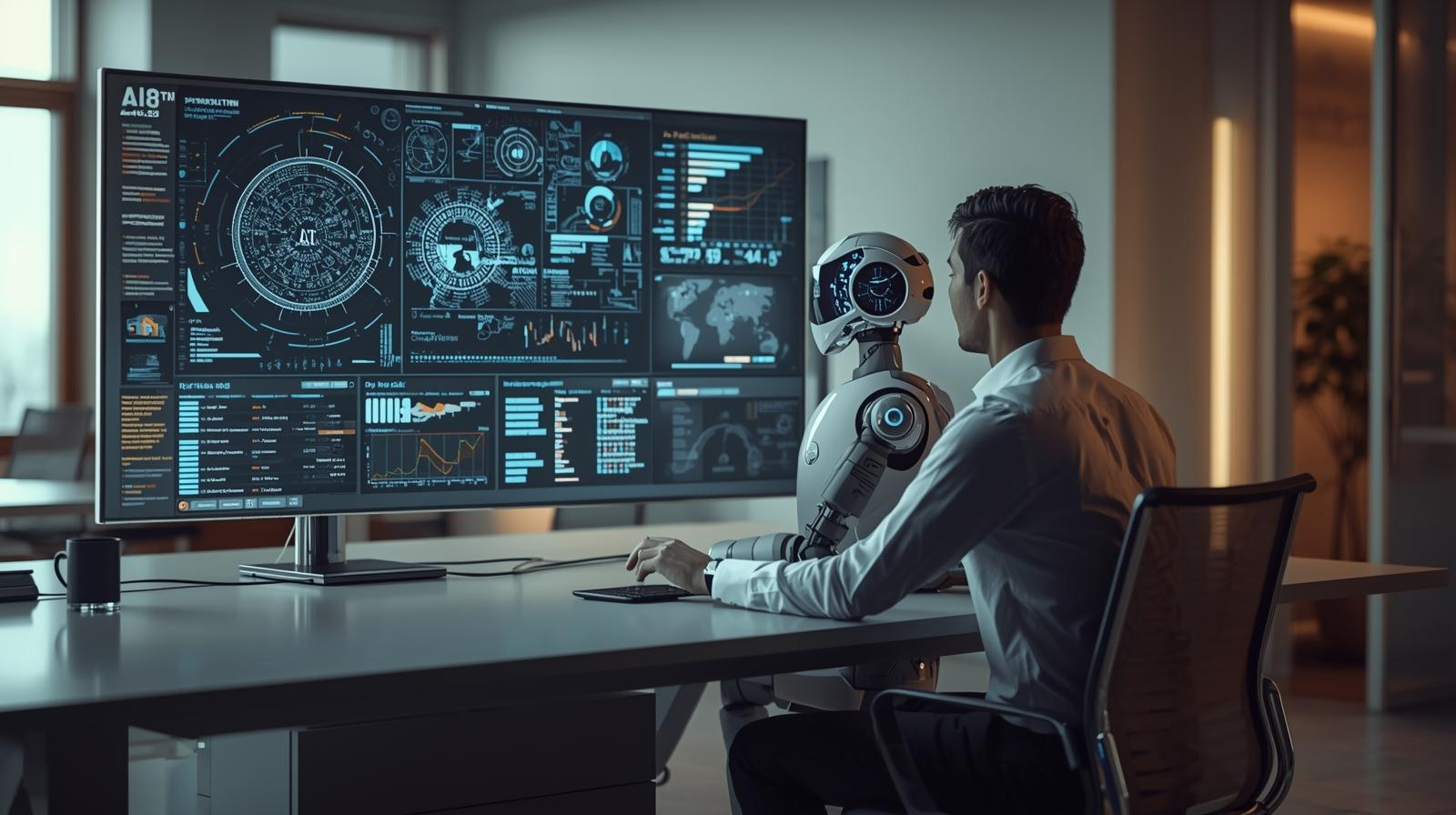
2025 is becoming the defining year for human-level artificial intelligence. From conversational models to autonomous reasoning systems, AI is evolving beyond automation toward understanding, adaptation, and empathy.
- The Rise of Human-Level AI in 2025

Artificial Intelligence has dominated global headlines for over a decade, but 2025 feels differents
What was once a speculative dream—machines capable of understanding and reasoning like humans—is now an approaching reality. The race to create general-purpose, human-like AI systems has reached a tipping point, blending science fiction with the real world.
AI models are no longer just answering questions; they’re thinking contextually, maintaining long-term memory, and collaborating with humans in ways previously unimaginable. Major players like OpenAI, Anthropic, Google DeepMind, and xAI are leading this evolution, but the ripple effects reach every corner of society—from education to medicine to national security.

- From Tools to Partners — The Evolution of AI
For years, artificial intelligence was seen as a tool—a smart calculator that processed information and followed commands.
But new models in 2025 are adaptive entities. They interpret tone, predict emotional context, and even negotiate decisions.
Systems like GPT-5, Claude-3.5, and Gemini Ultra are capable of reasoning across multiple steps, dynamically verifying information, and integrating with real-time web sources. This convergence of reasoning and adaptability has turned AI into a true cognitive partner, not just a technical assistant.
Experts refer to this new stage as “Collaborative Intelligence”—a fusion of human intuition and machine precision. Businesses that integrate this symbiotic approach are already reporting faster innovation and reduced operational errors.
- AI in the Workforce — Threat or Transformation?
While some industries fear AI displacement, 2025 has proven the opposite in many fields.
Instead of replacing workers, AI has become a force multiplier. In healthcare, AI agents analyze patient data, detect early signs of disease, and propose personalized treatments. In education, tutors powered by large models provide one-on-one instruction at scale.
Yet, the transformation isn’t without challenges. Automation is outpacing reskilling, and policymakers are struggling to define ethical frameworks for AI accountability. “We’re entering an era where algorithms make life-changing decisions,” says Dr. Maria Tsu, ethics researcher at Stanford University. “Transparency and human oversight are no longer optional—they’re essential.”
- Ethics, Regulation, and the Global AI Charter
In 2025, over 40 countries signed the Global AI Responsibility Charter, a multinational agreement establishing standards for data privacy, AI safety, and algorithmic transparency.
The goal is to ensure that the benefits of AI don’t come at the cost of human rights or democracy.
The Charter mandates that all advanced AI systems undergo bias auditing, energy-efficiency testing, and human-in-the-loop verification before deployment. Although enforcement varies by region, this marks the first global effort to synchronize ethical AI governance.
Private companies are also stepping up. OpenAI has pledged to make all frontier models “alignment transparent” by 2026, while DeepMind and Anthropic are focusing on interpretability research—understanding why an AI makes a certain decision.
- The Future — Coexistence or Competition?
As AI models become more capable, humanity faces a philosophical question: do we want machines that serve us or machines that collaborate with us?
The line between human and artificial cognition is blurring. Some futurists argue that by 2030, we’ll see the first examples of synthetic consciousness—AI systems that develop self-awareness.
Still, others warn against over-romanticizing AI’s progress. True human intelligence isn’t just logic—it’s empathy, emotion, and creativity. Even the most advanced models today simulate these qualities rather than feel them.
Yet, there’s no denying that 2025 represents a major inflection point. The world’s most powerful technology is learning to understand us—not as users, but as collaborators.
- Conclusion
The journey toward human-level AI isn’t just about creating smarter machines; it’s about redefining intelligence itself.
What started as a computational revolution has become a moral and societal one. If managed responsibly, this evolution could transform civilization in ways as profound as the invention of electricity or the internet.
The next few years will determine whether AI becomes our greatest ally or our most unpredictable rival.